A product evolution, not a blank-sheet replacement
IBM describes Maximo Real Estate and Facilities as the evolution of IBM TRIRIGA. From Maximo Application Suite 9.1, the real estate and facilities application became part of the Maximo family while retaining the capabilities organisations use to manage leases, spaces, capital programs, facilities operations, energy and environmental performance.
For current clients, that distinction matters. The accumulated value in portfolio data, configured processes, integrations and operating knowledge does not become irrelevant because the product name changes. It becomes the foundation for a planned transition into the Maximo Application Suite architecture.
What carries forward
- Real estate portfolio, lease administration and lease accounting capabilities.
- Space, workplace, reservation and occupancy management.
- Capital planning, project delivery and facility condition assessment.
- Facilities maintenance, service management and operational workflows.
- Environmental, energy and sustainability information.
- The configurable data, workflow and integration patterns established in TRIRIGA programs.
What changes inside Maximo Application Suite
Maximo Real Estate and Facilities is installed and accessed as an application in Maximo Application Suite. User access and AppPoint entitlements are managed through the suite, while the application retains its specialised real estate and facilities navigation and functions.
The wider suite creates a stronger path between portfolio planning and day-to-day asset management. IBM documentation highlights access to broader Maximo capabilities, including real-time IoT information from Maximo Monitor, and IBM's current product direction adds AI-assisted document intelligence, workflow automation and analytics to real estate and facilities processes.
This is not an automatic technical conversion. An existing estate still requires deliberate planning for platform level, deployment model, database, licensing, integrations, identity, custom configuration and change management.
Why IBM is bringing the disciplines together
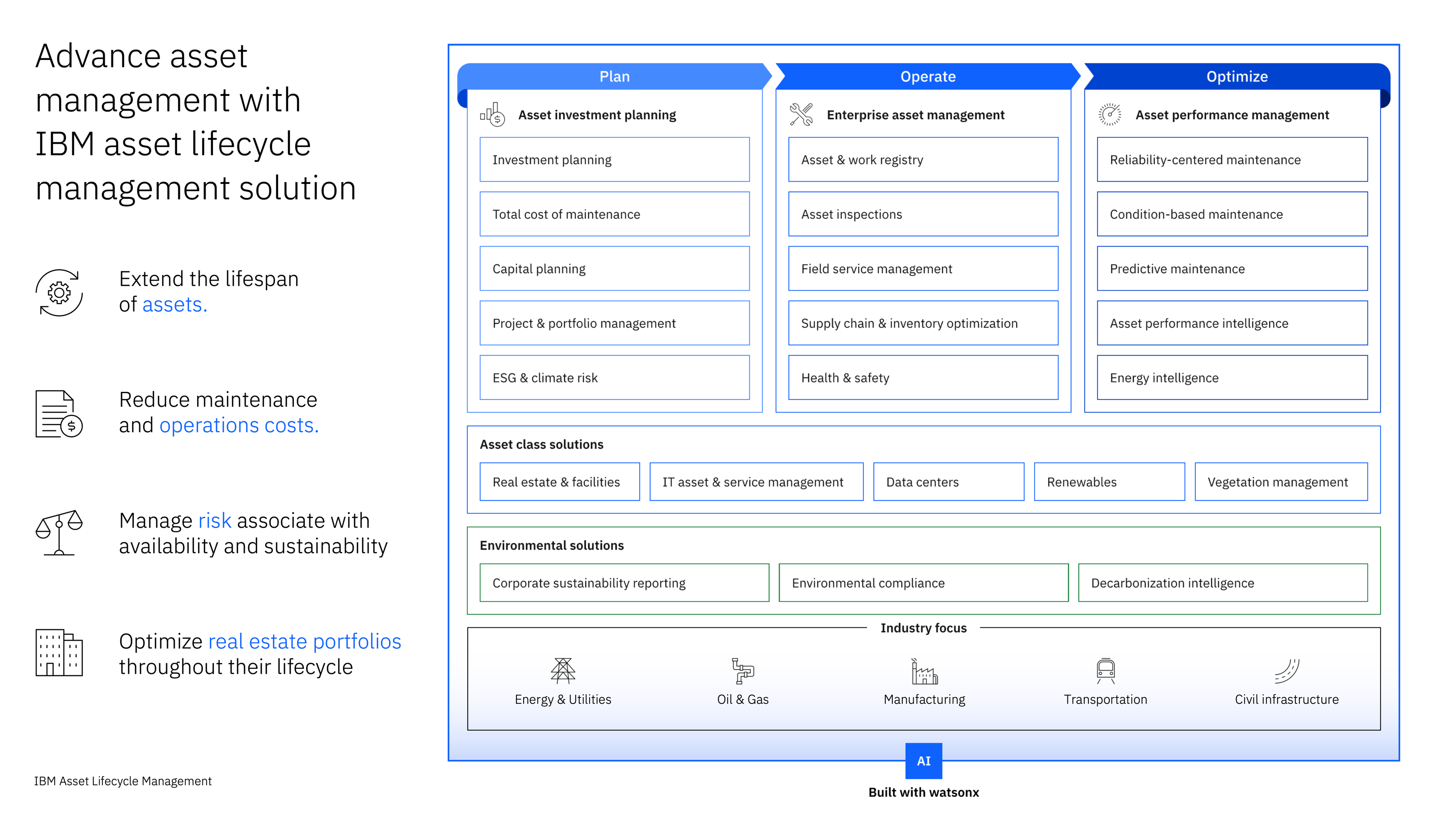
IBM now positions Maximo as a unified asset lifecycle management solution: connecting investment planning, enterprise asset management, asset performance, field service, inventory, real estate and facilities. The objective is to improve decisions across the full lifecycle, from where to invest, through how assets and spaces are operated, to how condition and performance inform the next plan.
For asset-intensive organisations, this can reduce the artificial boundary between a building, the equipment inside it, the services delivered from it and the investment decisions that shape its future. IBM Maximo and IBM watsonx provide the asset management and AI foundations; business value still depends on trustworthy data, coherent processes and disciplined adoption.
The current transition path
IBM identifies Maximo Real Estate and Facilities 9.x as the designated upgrade path for IBM TRIRIGA. IBM has also published lifecycle milestones for the existing TRIRIGA and TRIRIGA Application Suite offerings, including completion of standard support on 30 September 2027 and conditions for sustained, extended and dual support beyond that date.
Those dates make roadmap planning important, but they should not drive a rushed migration. Organisations should confirm their entitlements and current IBM support position, assess technical readiness, and sequence the transition around operational risk and business priorities. IBM support notices remain the authoritative source for dates and eligibility.
A practical roadmap for existing TRIRIGA clients
- Inventory versions, deployment architecture, integrations, customisations and reporting dependencies.
- Confirm licensing, AppPoint entitlements, support milestones and the target deployment model with IBM.
- Treat data quality, identity, integration and environment readiness as first-class workstreams.
- Use the transition to align real estate, facilities and enterprise asset strategies rather than reproduce every historic boundary.
- Protect proven business processes while retiring configuration that no longer creates operational value.
- Plan testing, cutover, adoption and support around the services that facilities teams must keep running.
Trixi's perspective
The new product structure creates continuity and opportunity. Trixi's experience with TRIRIGA data, workflows, integrations and operating models remains directly relevant, while the Maximo family opens a wider conversation about asset investment, maintenance, reliability, spatial intelligence, sustainability and AI-enabled work.
The best next step is not a generic migration estimate. It is a focused readiness assessment that connects IBM's product roadmap to the organisation's estate, asset risks and service priorities.